

Origins of the sweetness derived from the aging of dry wines: the role of oak triterpenoids Original language of the article: French.

Aging in barrel affects the sensory characteristics of wines and modifies the sweet taste in particular. Using an inductive approach, several sweet triterpenes, QTTs, have been identified in oak. Quantitative analysis has shown a significant species effect: sessile oak releases more sweet triterpenes while pedunculate oak is richer in bitter triterpenes. It is now possible to differentiate the two species on the basis of their triterpene composition.
Introduction
For nearly two thousand years, people have used wooden containers for the transport and production of wines and spirits. Over the centuries, the type of wood used to make barrels, techniques to design them and the uses made of them have evolved on the basis of empirical observation and experiment. Nowadays, barrels are almost all made of oak; they are reserved for aging and, sometimes, vinification. The composition of wines, their stability and their sensory characteristics change on contact with oak. In practice, contributions from aroma and taste compounds are observed. The molecular origin of the aromatic contribution to wines in contact with oak is well known. Vanillin, whisky lactone, volatile phenols such as eugenol or guaiacol, and 2-furanemethanethiol are the key volatile compounds.
In parallel with this aromatic contribution, it has been shown that dry wines gain in sweet taste on contact with oak, and that volatile compounds such as vanillin are not responsible for this phenomenon
Development of a purification protocol guided by taste
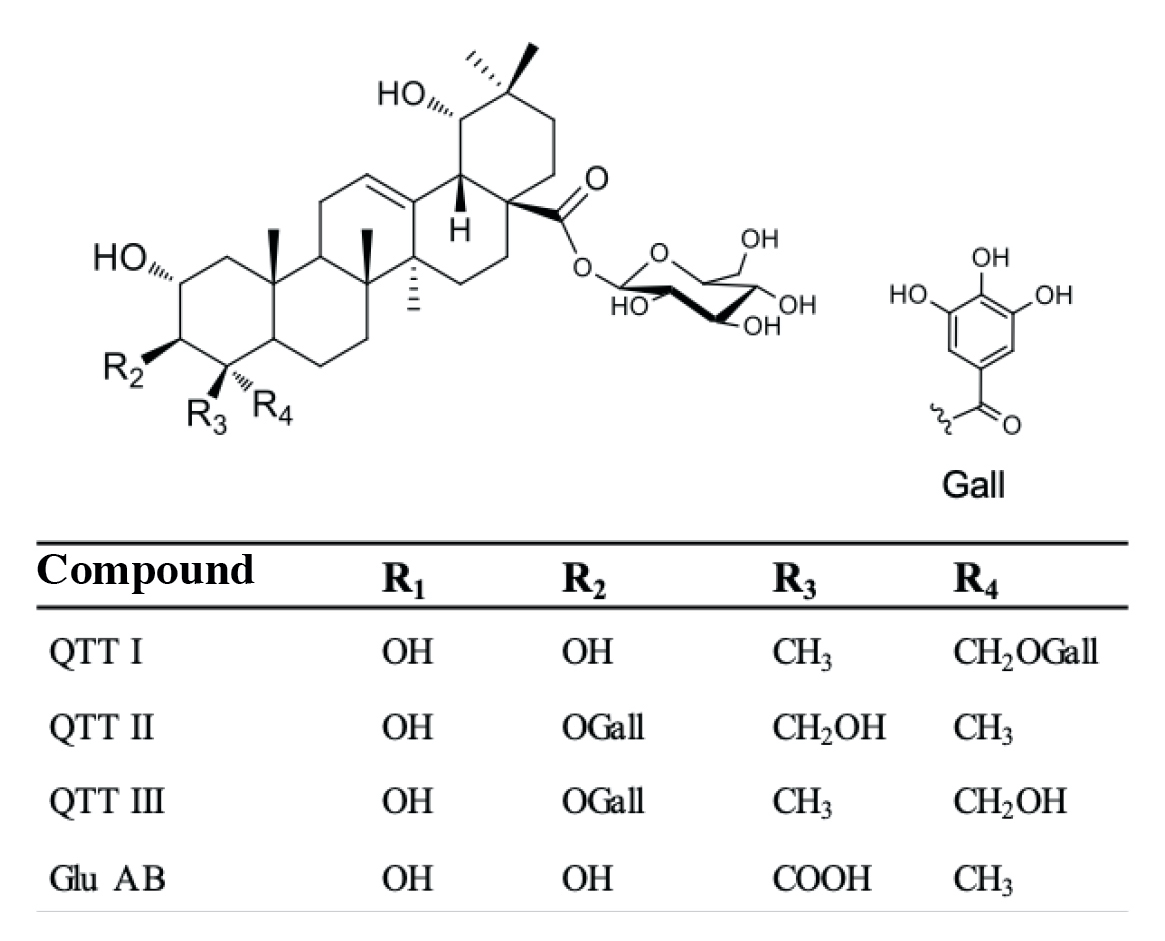
To characterize the molecules in oak responsible for the gain in sweet taste observed during aging, an inductive approach was taken. Several separation techniques were used and, at the end of each stage, the different fractions were tasted in order to retain only the sweetest. A macerate of untoasted oak was thus subjected to successive liquid-liquid extractions and then to centrifugal partition chromatography (CPC). This technique, frequently used in pharmacognosy to search for bioactive molecules, allowed fractionation of the extract. Its coupling with sensory analysis, for the first time, has been named CPC-Gustatometry, by analogy with Gas Chromatography-Olfactometry used in aroma analysis. Its use allowed isolation of a sweet fraction containing four compounds, which were then purified by HPLC. Two of these compounds have been shown to have a sweet taste. Their characterization by nuclear magnetic resonance spectroscopy revealed that they are glucosylated and galloylated triterpenes. These compounds, never before identified in nature, have been named Quercotriterpenoside (QTT) I and II (Fig. 1)
Search for new flavorful triterpenes
The discovery of these two sweet compounds has brought to light the triterpene family, which had been little studied in oak. To overcome this lack of knowledge, Fourier Transform mass spectrometry was used to search for the presence of other triterpenoids in oak, differing from QTTs by the nature of their aglycone (their basic skeleton) or by the position, number and type of their functional groups. This screening revealed the existence of many compounds, most of which could be isolated
Figure 1. Chemical structures of some oak triterpenes.
Influence of the oak species on QTT content
A method for assaying QTT I, II and III (all sweet) as well as Glu-AB (bitter) by LC-HRMS has been developed and validated. It has been applied to oak extracts to study the influence of oak species on triterpene composition. For this, samples were taken from 46 trees in 8 French forests: a leaf sample to determine the species by genetic analysis, in collaboration with UMR Biogeco
In each forest, samples of both species were observed (27 sessile oak, 19 pedunculate oak). Triterpenes were detected in all samples, at concentrations up to 1 mg/g of wood. The application of a statistical test showed significantly higher mean QTT content in the sessile oak samples than in pedunculate oak
Figure 2. Average QTT I, II, III and Glu-AB concentrations measured in sessile and pedunculate oak wood samples.
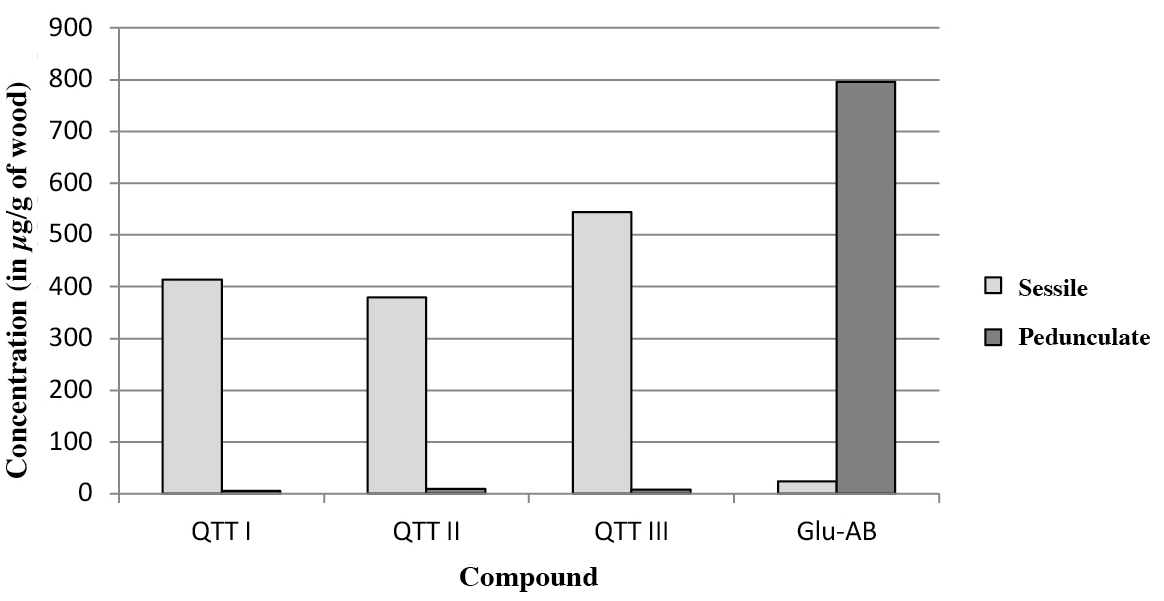
These results establish the marked influence of oak species on the triterpene content and suggest its sensory consequences. Sessile oak is indeed richer in sweet triterpenes (QTTs) while pedunculate oak contains more bitter triterpenes (Glu-AB). Given the strong inter-individual variability observed within each species, none of these triterpene compounds can, individually, allow for certain identification of the botanical origin of a wood sample. The same is true for the other compounds extractable from oak known to date, so identification of the species of a sample can only be carried out using the genetic analyses mentioned above. However, the examination of the chromatograms obtained during the analysis of the 46 samples showed a species influence on the triterpene profile of the oak. In order to translate this triterpene profile into a quantifiable value, a triterpene index (TI) has been defined as follows:
Figure 3. Average TI values calculated for the 46 samples of sessile and pedunculate oak analyzed.
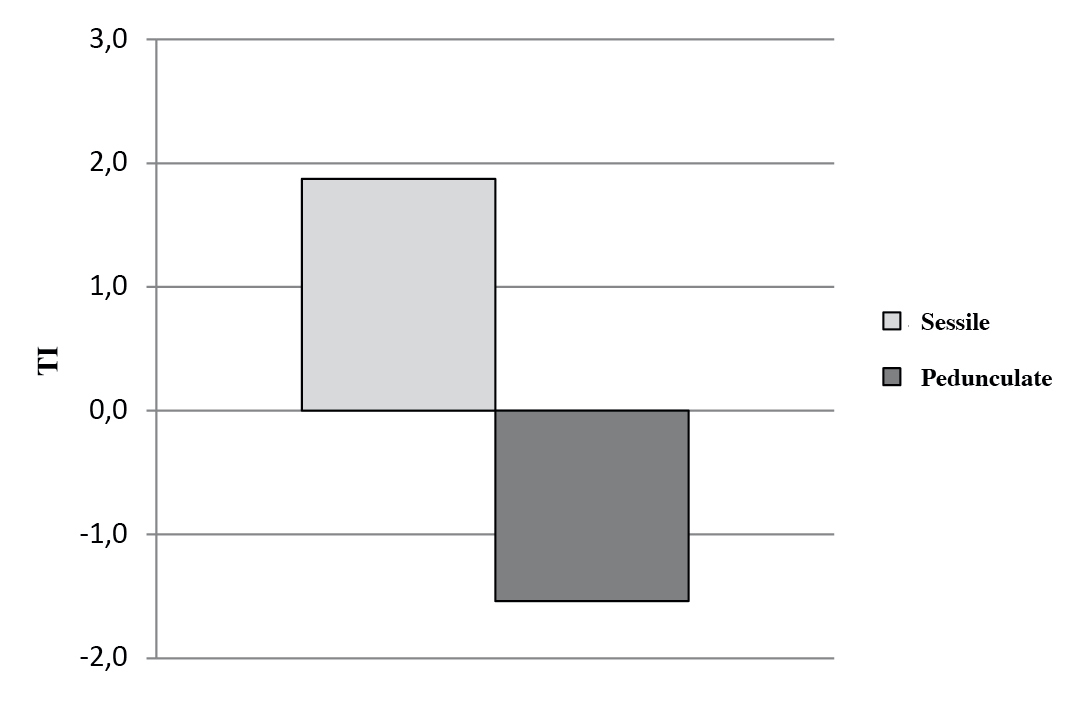
The mean TI was positive for sessile oak and negative for pedunculate oak (1.9 and -1.5 respectively) and the differences observed between the two species were significant at 0.1 %. In addition, the standard deviations obtained for each species were very small, reflecting small inter-individual differences. Measuring TI in wood thus appears to be the first chemical method to identify the species of cooperage oak. It has given rise to a patent filed in Europe and the United States, and now being worked.
Conclusion
The work undertaken to shed light on the compounds responsible for the increase in sweet taste perceived with oak aging has led to the identification of several oak triterpenes. These compounds depend strongly on the species of oak used in cooperage. It is now possible to distinguish sessile oak from pedunculate, by a simple chemical analysis carried out on seasoned and even toasted oak. This work opens up new prospects for the selection of cooperage oak and its adaptation to suit the identity of the wines produced.
The translation of this article into English was offered to you by Moët Hennessy.
NOTES
- Marchal, A.; Pons, A.; Lavigne, V.; Dubourdieu, D. Contribution of Oak Wood Ageing to the Sweet Perception of Dry Wines. Aust. J. Grape Wine Res. 2013, 19 (1), 11–19.
- Marchal, A.; Waffo-Téguo, P.; Génin, E.; Mérillon, J. M.; Dubourdieu, D. Identification of New Natural Sweet Compounds in Wine Using Centrifugal Partition Chromatography-Gustatometry and Fourier Transform Mass Spectrometry. Anal. Chem. 2011, 83 (24), 9629–9637.
- Gammacurta, M.; Waffo-Teguo, P.; Winstel, D.; Cretin, B. N.; Sindt, L.; Dubourdieu, D.; Marchal, A. Triterpenoids from Quercus Petraea: Identification in Wines and Spirits and Sensory Assessment. J. Nat. Prod. 2019. https://doi.org/10.1021/acs.jnatprod.8b00682.
- Arramon, G.; Saucier, C.; Colombani, D.; Glories, Y. Identification of Triterpene Saponins in Quercus Robur L. Q. Petraea Liebl. Heartwood by LC-ESI/MS and NMR. Phytochem. Anal. 2002, 13 (6), 305–310.
- Guichoux, E.; Lagache, L.; Wagner, S.; Léger, P.; Petit, R. J. Two Highly Validated Multiplexes (12-Plex and 8-Plex) for Species Delimitation and Parentage Analysis in Oaks (Quercus Spp.). Mol. Ecol. Resour. 2011, 11 (3), 578–585. https://doi.org/10.1111/j.1755-0998.2011.02983.x.
- Marchal, A.; Prida, A.; Dubourdieu, D. New Approach for Differentiating Sessile and Pedunculate Oak: Development of a LC-HRMS Method To Quantitate Triterpenoids in Wood. J. Agric. Food Chem. 2016, 64 (3), 618–626. https://doi.org/10.1021/acs.jafc.5b05056.
- Prida, A.; Ducousso, A.; Petit, R. J.; Nepveu, G.; Puech, J. L. Variation in Wood Volatile Compounds in a Mixed Oak Stand: Strong Species and Spatial Differentiation in Whisky-Lactone Content. Ann. For. Sci. 2007, 64 (3), 313–320.
- Prida, A.; Boulet, J. C.; Ducousso, A.; Nepveu, G.; Puech, J. L. Effect of Species and Ecological Conditions on Ellagitannin Content in Oak Wood from an Even-Aged and Mixed Stand of Quercus Robur L. and Quercus Petraea Liebl. Ann. For. Sci. 2006, 63 (4), 415–424.
References
- Marchal, A.; Pons, A.; Lavigne, V.; Dubourdieu, D. Contribution of Oak Wood Ageing to the Sweet Perception of Dry Wines. Aust. J. Grape Wine Res. 2013, 19 (1), 11–19.
- Marchal, A.; Waffo-Téguo, P.; Génin, E.; Mérillon, J. M.; Dubourdieu, D. Identification of New Natural Sweet Compounds in Wine Using Centrifugal Partition Chromatography-Gustatometry and Fourier Transform Mass Spectrometry. Anal. Chem. 2011, 83 (24), 9629–9637.
- Gammacurta, M.; Waffo-Teguo, P.; Winstel, D.; Cretin, B. N.; Sindt, L.; Dubourdieu, D.; Marchal, A. Triterpenoids from Quercus Petraea: Identification in Wines and Spirits and Sensory Assessment. J. Nat. Prod. 2019. https://doi.org/10.1021/acs.jnatprod.8b00682.
- Arramon, G.; Saucier, C.; Colombani, D.; Glories, Y. Identification of Triterpene Saponins in Quercus Robur L. Q. Petraea Liebl. Heartwood by LC-ESI/MS and NMR. Phytochem. Anal. 2002, 13 (6), 305–310.
- Guichoux, E.; Lagache, L.; Wagner, S.; Léger, P.; Petit, R. J. Two Highly Validated Multiplexes (12-Plex and 8-Plex) for Species Delimitation and Parentage Analysis in Oaks (Quercus Spp.). Mol. Ecol. Resour. 2011, 11 (3), 578–585. https://doi.org/10.1111/j.1755-0998.2011.02983.x.
- Marchal, A.; Prida, A.; Dubourdieu, D. New Approach for Differentiating Sessile and Pedunculate Oak: Development of a LC-HRMS Method To Quantitate Triterpenoids in Wood. J. Agric. Food Chem. 2016, 64 (3), 618–626. https://doi.org/10.1021/acs.jafc.5b05056.
- Prida, A.; Ducousso, A.; Petit, R. J.; Nepveu, G.; Puech, J. L. Variation in Wood Volatile Compounds in a Mixed Oak Stand: Strong Species and Spatial Differentiation in Whisky-Lactone Content. Ann. For. Sci. 2007, 64 (3), 313–320.
- Prida, A.; Boulet, J. C.; Ducousso, A.; Nepveu, G.; Puech, J. L. Effect of Species and Ecological Conditions on Ellagitannin Content in Oak Wood from an Even-Aged and Mixed Stand of Quercus Robur L. and Quercus Petraea Liebl. Ann. For. Sci. 2006, 63 (4), 415–424.
Article statistics
 Views: 3101
Downloads
 PDF: 424