

Discriminating the fruity nuances in red wines with untrained assessors using CATA methodology This article presents original research results (that have not been published in a peer‑reviewed scientific journal).
The fruity aroma of red wines plays an important role in both wine quality and consumer liking. However, the perceptual reality of red- and black-berry fruity nuances remains a complex sensory concept. This work used Check-All-That-Apply (CATA), a fast, intuitive method in which panelists check attributes from a predefined list, to investigate whether untrained assessors can perceive the fruity nuances of red wines. Given its practicality for the wine industry, this work showed that untrained panels, coupled with CATA, can effectively distinguish red wines from different regions based on fruity nuances.
Fruity aroma of red wine: a complex sensory concept
The fruity aroma of red wines is defined by a wide range of descriptors, from fresh red- and black-berry fruits to ripe fruits, including candied and cooked fruits
The fruity aroma of red wine is often analyzed using quantitative descriptive analysis (QDA), especially sensory profiles based on intensity scores via scaling. Furthermore, QDA is time-consuming and requires intensive training of the panel on the selected descriptors, which is not practical for professionals
The purposes of this study were: (1) to inform professionals in the wine sector as to whether the CATA method is effective when used in conjunction with a panel of untrained panelists; (2) to demonstrate whether this method can distinguish red wines based on their fruity nuances.
Red wine selection and CATA procedure
Five commercial single-varietal red wines made from the Carmenère, Grenache, Nebbiolo, Petit Verdot, and Xinomavro grape varieties were collected. Among the five single-varietal red wines, three were planted in regions with higher temperatures than Bordeaux (the Mediterranean Basin) and came from different countries: Greece (Xinomavro), Italy (Nebbiolo), and Spain (Grenache). The other two red wines were made from grape varieties planted in the Bordeaux vineyard (Carmenère and Petit Verdot). Carmenère wine was presented twice, under different codes, to assess panel consistency. These wines were produced using grapes from the 2019 vintage. All olfactory analyses were conducted in 2023.
Generally, CATA uses a multiple-choice questionnaire that presents a list of terms to characterize the samples. Participants simply select all the terms they consider most appropriate for describing the samples, after which the frequency with which each term is cited is determined
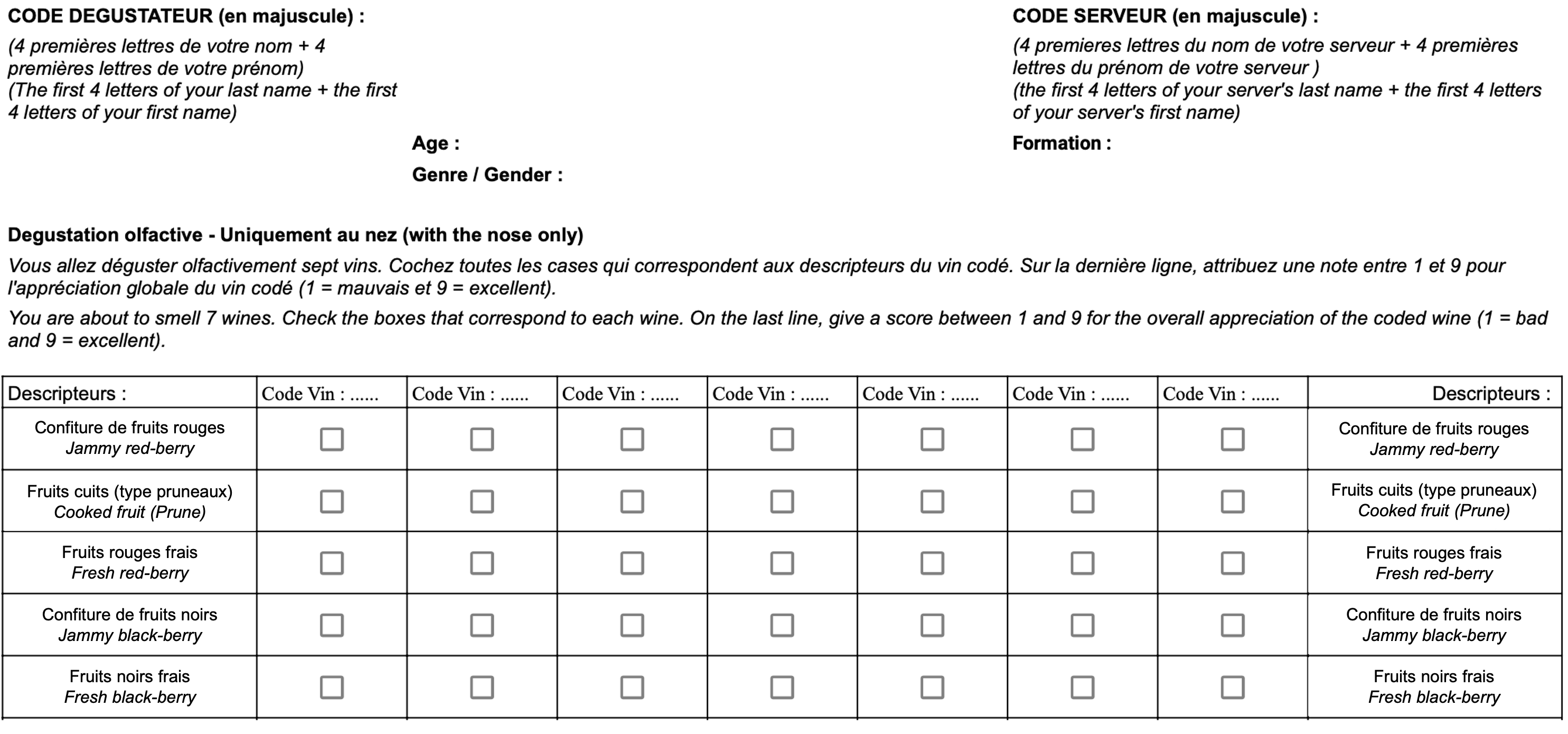
Figure 1. CATA questionnaire.
Red wines discrimination according to their fruity nuances
Figure 2 shows the CA analysis: wines located close to one another share similar characteristics, while attributes located near a given wine indicate higher citation frequencies for that wine. The axes covered 88.62 % of the total variability. In addition, the duplicate samples Carmenère 1 and 2 were close, highlighting good panel consistency. Figure 2 shows that assessors discriminated the wines by contrasting red-berry fruit notes with black-berry and cooked fruit notes, as indicated by axis 1, which explained the highest percentage of the data set’s variability (77.6 %). Axis 2 opposed the cooked fruit attribute to the black-berry fruit notes, but this does not carry much weight (11.02 %). In addition, assessors associated the wines made from Xinomavro and Nebbiolo with fresh and jammy red-berry fruit notes, while the wines made from Petit Verdot, Grenache, and Carmenère 1 and 2 were characterized by fresh and jammy black-berry fruit and cooked-fruit aromas.
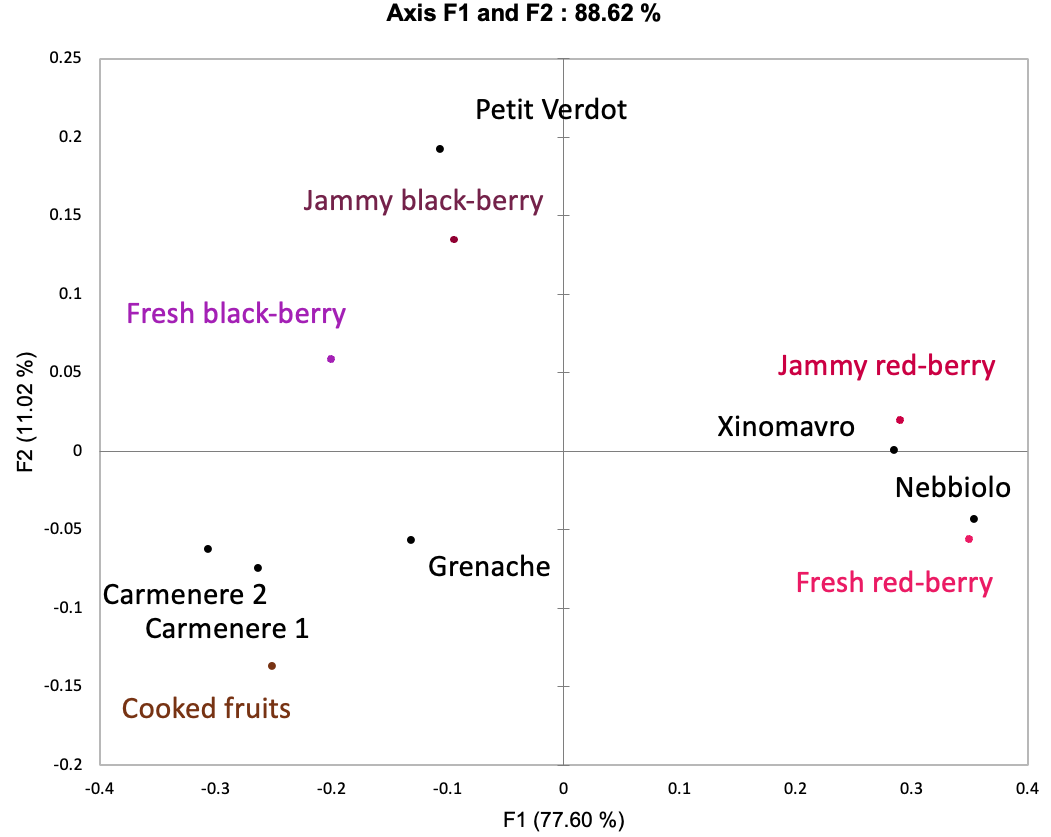
Figure 2. Correspondence Analysis (CA) conducted on the Check-All-That-Apply test (CATA) data obtained with 74 untrained assessors; wine labels in black, attribute labels in color.
These aromatic profiles are also shown on a spider graph (Figure 3). Cochran’s Q test applied to attribute citation frequencies showed significant effects for four attributes: fresh red-berry (p-value < 0.0001), jammy red-berry (p-value < 0.0001), fresh black-berry (p-value = 0.002), and cooked fruits (p-value = 0.047). The detailed significant differences, tested by Sheskin’s pairwise comparisons, are given in supplementary Table S1. Figure 3 shows that the wine made from Grenache was mostly described as having both cooked-fruit and fresh black-berry aromas. Wines made from Xinomavro and Nebbiolo were significantly perceived to have higher levels of fresh, jammy red-berry fruit notes than Carmenère 1 and 2 red wines. However, the panel described the Grenache and Petit Verdot red wines as having higher fresh black-berry fruit notes than the Nebbiolo. These results suggest that the untrained panel easily recognized red- and black-berry fruit notes but was less proficient at identifying jammy and cooked fruit notes. These would probably require some training to be used more effectively.
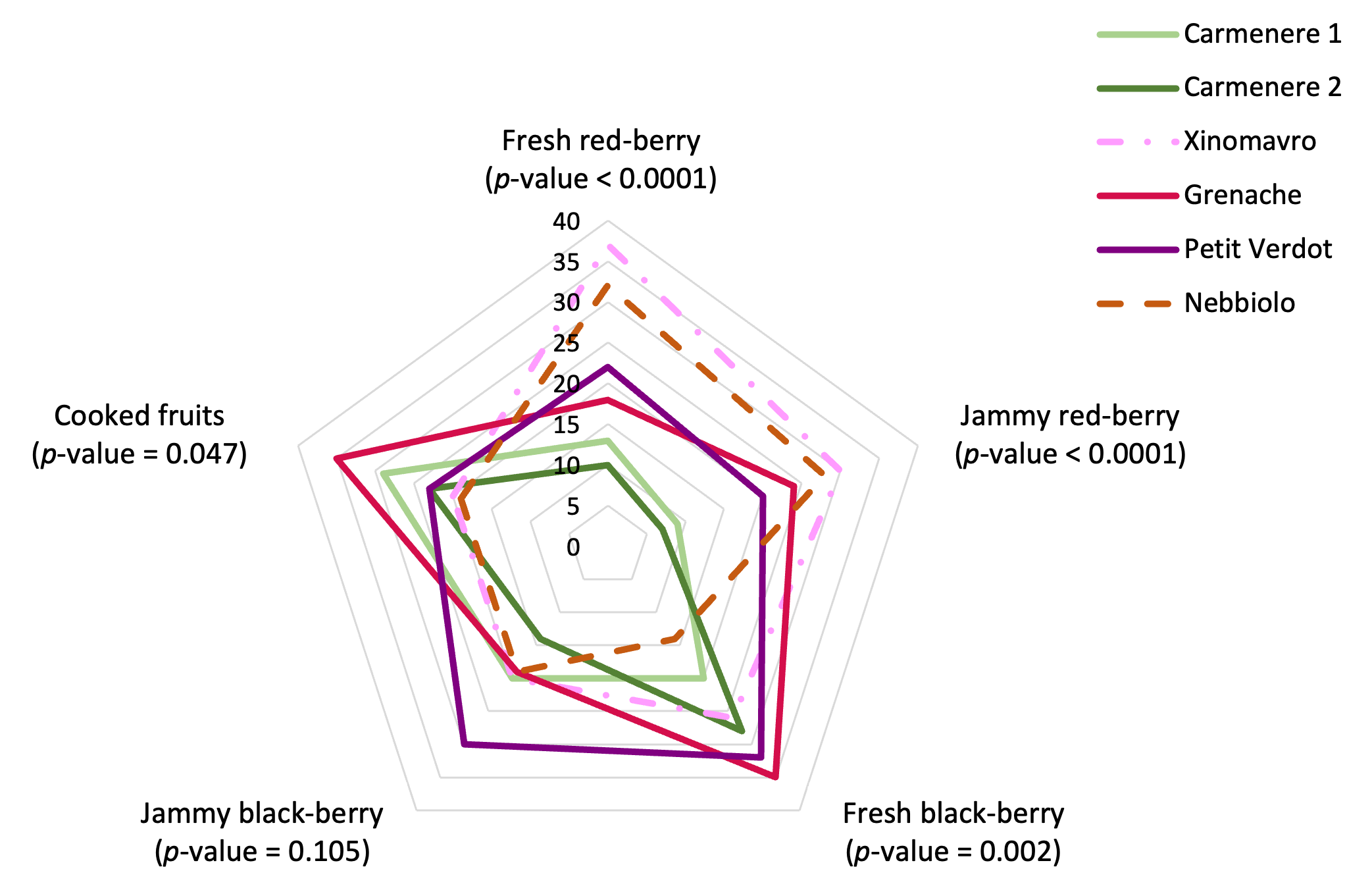
Figure 3. Spider maps of citation occurrences for the five olfactory attribute citations, obtained from CATA tests; p-values were calculated using Cochran’s Q test, n = 74 untrained assessors.
Finally, to determine the number of participants necessary for a statistically robust CA, a chi-square test was applied, as described previously
Conclusion
Although the fruity aroma of red wines is a complex sensory concept, the CATA methodology can be useful and powerful for evaluating perceptual differences in fruity nuances in red wines, even with untrained panels. Untrained assessors, who do not share common perceptual and cognitive representations of fruitiness in wines, could differentiate wines according to these nuances of red- and black-berry fruits. The notions of jammy and cooked fruit were less discriminative for the untrained panel. Therefore, it would be interesting to conduct further analyses by comparing this methodology with a QDA approach using a trained panel, to see how they perceived the fruity notes and discriminated the wines. Moreover, the selected wines were made in different countries, which can facilitate the perceptual discrimination among the samples. From a future perspective, it could be interesting to use this methodology with a set of red wines made from Bordeaux.
Acknowledgment: The authors thank all panel students for their time and participation. This work received financial support from Bordeaux Sciences Agro, the Regional Council of Nouvelle-Aquitaine, the Union des Œnologues de France, the Conseil Interprofessionnel des Vins de Bordeaux (CIVB), and the GPR (Grands Programmes de Recherche) – Bordeaux Plant Sciences, Université de Bordeaux. The authors also acknowledge the Vinid’Occ funding obtained from the Occitanie Regional Council and Toulouse INP for internal support.
The supplementary Table S1 is available here: https://ives-technicalreviews.eu/article/view/10509/56034

Notes
- 1. van Leeuwen, C., Barbe, J. C., Darriet, P., Destrac-Irvine, A., Gowdy, M., Lytra, G., Marchal, A., Marchand, S., Plantevin, M., Poitou, X., Pons, A., & Thibon, C. (2022). Aromatic maturity is a cornerstone of terroir expression in red wine: This article is published in cooperation with Terclim 2022 (XIVth International Terroir Congress and 2nd ClimWine Symposium), 3-8 July 2022, Bordeaux, France. OENO One, 56(2), 335-351. https://doi.org/10.20870/oeno-one.2022.56.2.5441
- 2. Ballester, J., Abdi, H., Langlois, J., Peyron, D., & Valentin, D. (2009). The odor of colors: can wine experts and novices distinguish the odors of white, red, and rosé wines? Chemosensory Perception, 2, 203-213. https://doi.org/10.1007/s12078-009-9058-0
- 3. Parr, W. V., Grose, C., Hedderley, D., Maraboli, M. M., Masters, O., Araujo, L. D., & Valentin, D. (2020). Perception of quality and complexity in wine and their links to varietal typicality: An investigation involving Pinot noir wine and professional tasters. Food Research International, 137, 109423. https://doi.org/10.1016/j.foodres.2020.109423
- 4. Francis, I. L., & Williamson, P. O. (2015). Application of consumer sensory science in wine research. Australian Journal of Grape and Wine Research, 21, 554-567. https://doi.org/10.1111/ajgw.12169
- 5. Lund, C. M., Thompson, M. K., Benkwitz, F., Wohler, M. W., Triggs, C. M., Gardner, R., Heymann, H., & Nicolau, L. (2009). New Zealand Sauvignon blanc Distinct Flavor Characteristics: Sensory, Chemical, and Consumer Aspects. American Journal of Enology and Viticulture, 60(1), 1‑12. https://doi.org/10.5344/ajev.2009.60.1.1
- 6. Ares, G., Antúnez, L., Bruzzone, F., Vidal, L., Giménez, A., Pineau, B., Beresford, M. K., Jin, D., Paisley, A. G., Chheang, S. L., Roigard, C. M., & Jaeger, S. R. (2015). Comparison of sensory product profiles generated by trained assessors and consumers using CATA questions: Four case studies with complex and/or similar samples. Food Quality and Preference, 45, 75‑86. https://doi.org/10.1016/j.foodqual.2015.05.007
- 7. Ares, G., Antúnez, L., Bruzzone, F., Vidal, L., Giménez, A., Pineau, B., Beresford, M. K., Jin, D., Paisley, A. G., Chheang, S. L., Roigard, C. M., & Jaeger, S. R. (2015). Comparison of sensory product profiles generated by trained assessors and consumers using CATA questions: Four case studies with complex and/or similar samples. Food Quality and Preference, 45, 75‑86. https://doi.org/10.1016/j.foodqual.2015.05.007
- 8. Geffroy, O., Maza, E., Lytra, G., & Chervin, C. (2024). ‘Liking then CATA’ or ‘CATA then liking’? Impact of the hedonic question positioning on the wine sensory description and appreciation. OENO One, 58(3). https://doi.org/10.20870/oeno-one.2024.58.3.8165
- 9. Geffroy, O., Maza, E., Lytra, G., & Chervin, C. (2024). ‘Liking then CATA’ or ‘CATA then liking’? Impact of the hedonic question positioning on the wine sensory description and appreciation. OENO One, 58(3). https://doi.org/10.20870/oeno-one.2024.58.3.8165
- 10. Geffroy, O., Maza, E., Lytra, G., & Chervin, C. (2024). ‘Liking then CATA’ or ‘CATA then liking’? Impact of the hedonic question positioning on the wine sensory description and appreciation. OENO One, 58(3). https://doi.org/10.20870/oeno-one.2024.58.3.8165
References
- van Leeuwen, C., Barbe, J. C., Darriet, P., Destrac-Irvine, A., Gowdy, M., Lytra, G., Marchal, A., Marchand, S., Plantevin, M., Poitou, X., Pons, A., & Thibon, C. (2022). Aromatic maturity is a cornerstone of terroir expression in red wine: This article is published in cooperation with Terclim 2022 (XIVth International Terroir Congress and 2nd ClimWine Symposium), 3-8 July 2022, Bordeaux, France. OENO One, 56(2), 335-351. https://doi.org/10.20870/oeno-one.2022.56.2.5441
- Ballester, J., Abdi, H., Langlois, J., Peyron, D., & Valentin, D. (2009). The odor of colors: can wine experts and novices distinguish the odors of white, red, and rosé wines? Chemosensory Perception, 2, 203-213. https://doi.org/10.1007/s12078-009-9058-0
- Parr, W. V., Grose, C., Hedderley, D., Maraboli, M. M., Masters, O., Araujo, L. D., & Valentin, D. (2020). Perception of quality and complexity in wine and their links to varietal typicality: An investigation involving Pinot noir wine and professional tasters. Food Research International, 137, 109423. https://doi.org/10.1016/j.foodres.2020.109423
- Francis, I. L., & Williamson, P. O. (2015). Application of consumer sensory science in wine research. Australian Journal of Grape and Wine Research, 21, 554-567. https://doi.org/10.1111/ajgw.12169
- Lund, C. M., Thompson, M. K., Benkwitz, F., Wohler, M. W., Triggs, C. M., Gardner, R., Heymann, H., & Nicolau, L. (2009). New Zealand Sauvignon blanc Distinct Flavor Characteristics: Sensory, Chemical, and Consumer Aspects. American Journal of Enology and Viticulture, 60(1), 1‑12. https://doi.org/10.5344/ajev.2009.60.1.1
- Ares, G., Antúnez, L., Bruzzone, F., Vidal, L., Giménez, A., Pineau, B., Beresford, M. K., Jin, D., Paisley, A. G., Chheang, S. L., Roigard, C. M., & Jaeger, S. R. (2015). Comparison of sensory product profiles generated by trained assessors and consumers using CATA questions: Four case studies with complex and/or similar samples. Food Quality and Preference, 45, 75‑86. https://doi.org/10.1016/j.foodqual.2015.05.007
- Geffroy, O., Maza, E., Lytra, G., & Chervin, C. (2024). ‘Liking then CATA’ or ‘CATA then liking’? Impact of the hedonic question positioning on the wine sensory description and appreciation. OENO One, 58(3). https://doi.org/10.20870/oeno-one.2024.58.3.8165