

Canned wine in a traditional region: how expectations and consumer involvement shape perception Sourced from the research article: “Wine in a can: A consumer study in a traditional wine-producing region. Effect of the level of consumer involvement” (OENO One, 2025). Original language of the article: English.

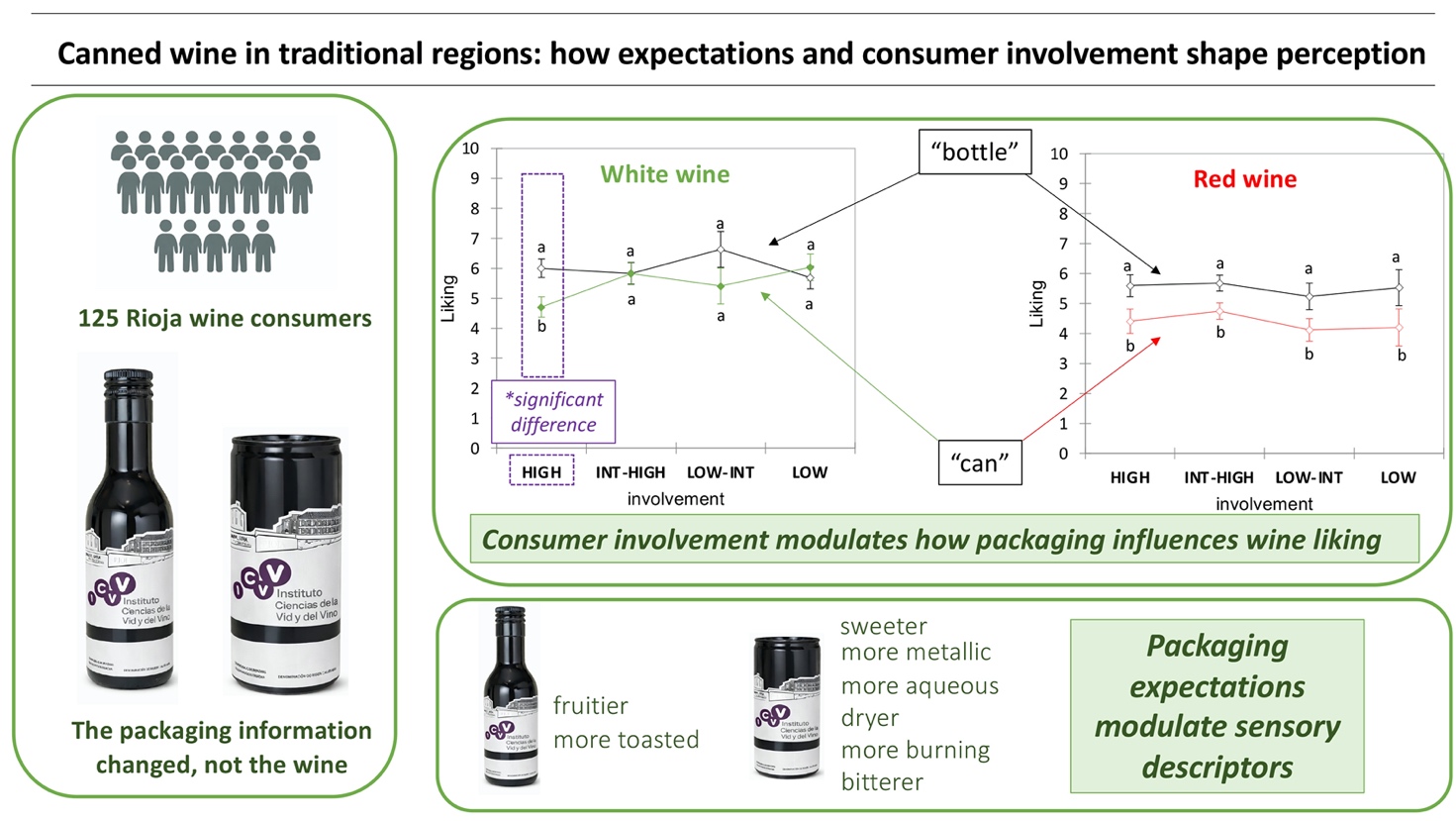
Canned wine is gaining traction, but in traditional regions packaging can shape perceived quality through top-down expectations. In a Rioja study (125 consumers), identical red and white wines were presented as either “bottled” or “canned”. Consumer involvement was a key driver of preference: only highly involved consumers showed a strong liking penalty for canned white wine, while bottled red wine was consistently preferred. Canned wines were also described as being more metallic and less fruity, confirming expectation-driven sensory bias. These findings highlight the importance of considering consumer involvement when introducing alternative wine packaging in traditional markets.
Graphical abstract
Context
Canned wine is moving from a niche concept to a credible commercial format, supported by clear advantages related to logistics, portability and sustainability
Experiment
A total of 125 non-professional wine consumers from the traditional Rioja wine-producing region participated in a controlled tasting session. Two young wines (one white Viura and one red Tempranillo Tinto) were evaluated under two conditions: “bottle” vs “can”. Importantly, the wines were always poured from the same bottle, thus the intrinsic product did not change; only the packaging information provided to participants differed. Identical label designs were used for the two formats, and the corresponding container (a 125 mL bottle or a 200 mL can) was placed in front of the glass to reinforce the context. Participants rated perceived quality and liking on 10-point scales and described each sample using Rate-All-That-Apply (RATA) (26 attributes). Finally, they completed a validated questionnaire to classify them into four involvement levels (low to high).
Consumer involvement modulates the impact of packaging on quality and liking
Although the wines were identical in both conditions (only the information “bottle” versus “can” changed), packaging cues significantly influenced perceived quality and, in some cases, liking - showing that consumer evaluation is strongly driven by cognitive expectations.
For white wine, perceived quality was higher in the bottle condition than in the can condition (5.8 vs 5.3; F = 9.1, p < 0.01). Liking also depended on packaging (F = 6.5, p < 0.05) and, importantly, on involvement level, with a significant condition × involvement interaction (F = 3.9, p < 0.05). In practical terms, only highly-involved consumers showed a clear preference for bottled white wine over canned white wine (6.0 vs 4.7). The other involvement groups did not show significant liking differences between conditions (Figure 1a).
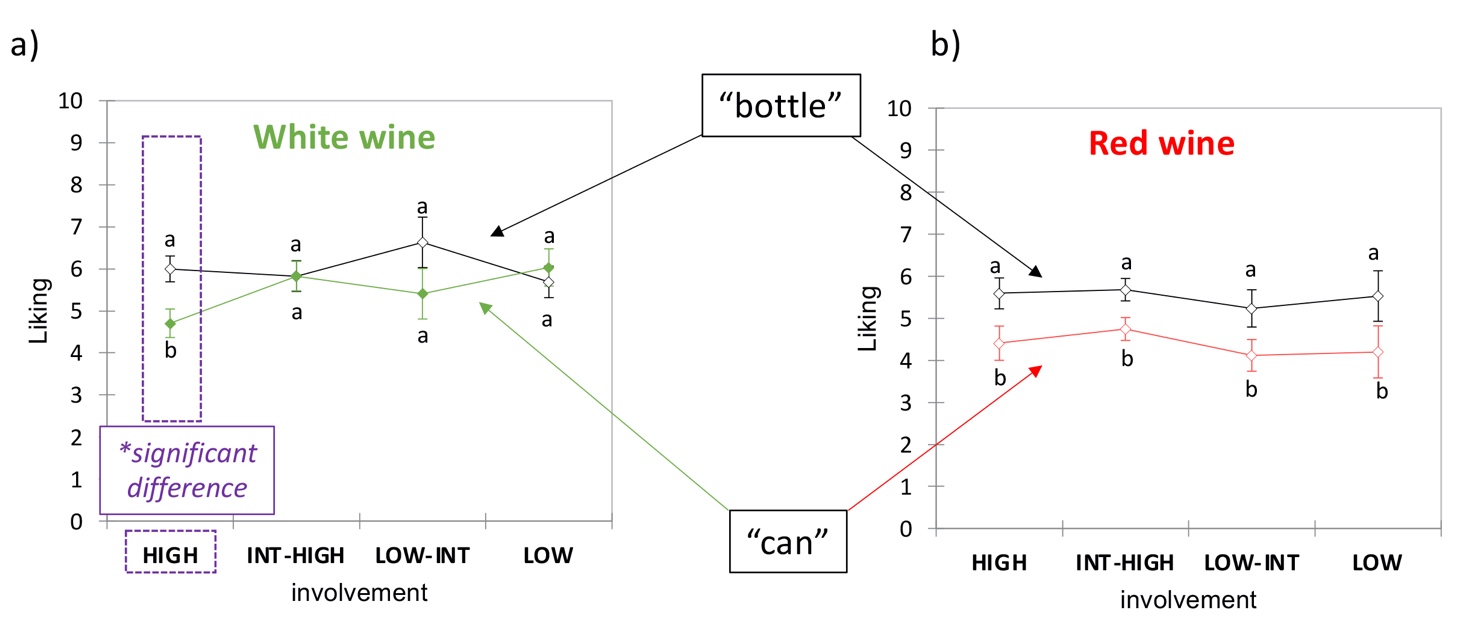
Figure 1. Averaged scores of liking rated by the four groups of consumers for the bottle and can conditions for a) white wine and b) red wine. Different letters indicate significant differences according to Bonferroni pair-wise post-hoc tests.
For red wine, can packaging had a consistent negative impact on both liking (F = 15.9, p < 0.001) and perceived quality (F = 12.3, p < 0.001), with no interaction with involvement. Across all consumer segments, red wine labelled as bottled was preferred (5.5 vs 4.6) and perceived as being of higher quality (5.3 vs 4.6) than the same wine labelled as canned (Figure 1b).
These results show that consumer involvement does not simply change preferences; it determines when packaging innovation translates into a hedonic penalty. For white wines, the can may be broadly acceptable, except among the most engaged, tradition-oriented consumers.
Top-down effects on sensory descriptors as a function of packaging
Beyond overall preference and quality scores, the study also shows that packaging cues influence how consumers describe the sensory characteristics of the wines, even though the wine never contacted aluminium. This is a clear top-down effect: consumers perceive the wine through an expectation filter created by the container format.
Across all consumers, white wine labelled as canned was described as being lower in white/yellow fruit (1.3 vs 1.8; F = 5.5, p < 0.05) and more metallic (0.68 vs 0.01; F = 23.3, p < 0.0001) than the same wine labelled as bottled.
Crucially, the direction and intensity of these differences depended on involvement level (Figure 2):
- Highly involved consumers described canned white wine as more bitter (1.4 vs 0.5; F = 8.5, p < 0.01) and more drying/astringent (0.9 vs 0.3; F = 4.4, p < 0.05), and less light in flavour (1.3 vs 2.1; F = 4.1, p < 0.05) than bottled.
- Low involvement consumers perceived canned white wine as lower in white fruit (0.9 vs 1.7; F = 7.7, p < 0.05) and sweeter (2.0 vs 1.0; F = 4.9, p < 0.05).
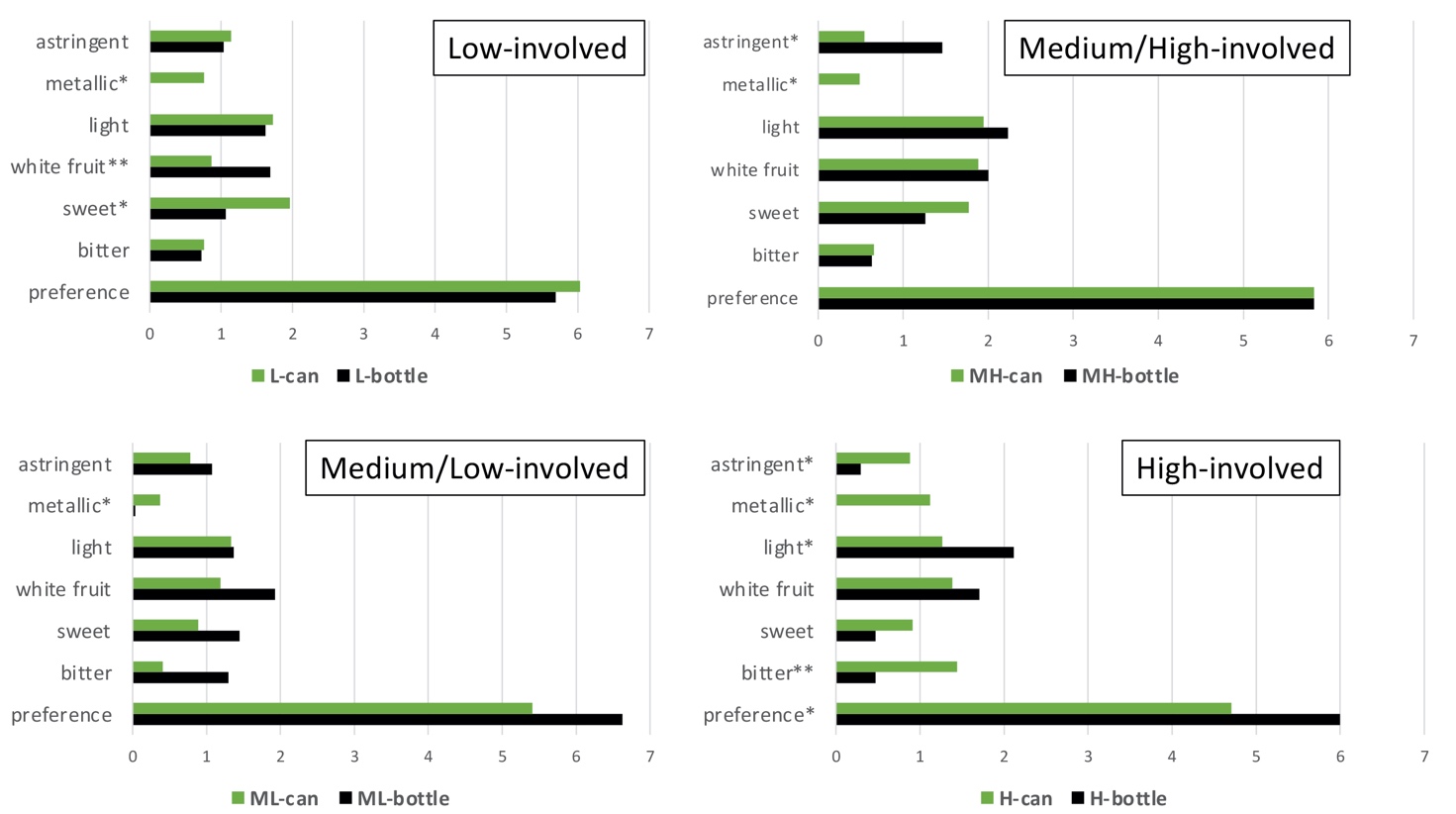
Figure 2. Averaged scores of the descriptors rated for the white wine by the four groups of consumers. Descriptors differing significantly between the can and bottle conditions are marked: *p< 0.05; **p< 0.01.
For red wine, the can label also shifted sensory perception. Compared to bottled, canned red wine was described as more aqueous (0.8 vs 0.4; F = 5.5, p < 0.05) and more metallic (1.0 vs 0.0; F = 37.8, p < 0.0001), and as lower in black fruit (0.8 vs 1.4; F = 5.5, p < 0.05) and less toasted (0.3 vs 0.6; F = 5.1, p < 0.05).
Once again, involvement shaped which descriptors were most affected (Figure 3):
- Highly involved consumers perceived canned red wine as lower in red fruit (1.6 vs 2.8; F = 6.6, p < 0.05) and sweeter (0.7 vs 0.2; F = 4.0, p < 0.05).
- Medium-high involvement consumers described canned red wine as more burning (1.3 vs 0.4; F = 7.0, p < 0.05).
- Low involvement consumers reported a marked increase in metallic perception for canned red wine (1.5 vs 0.1; F = 11.2, p < 0.01).
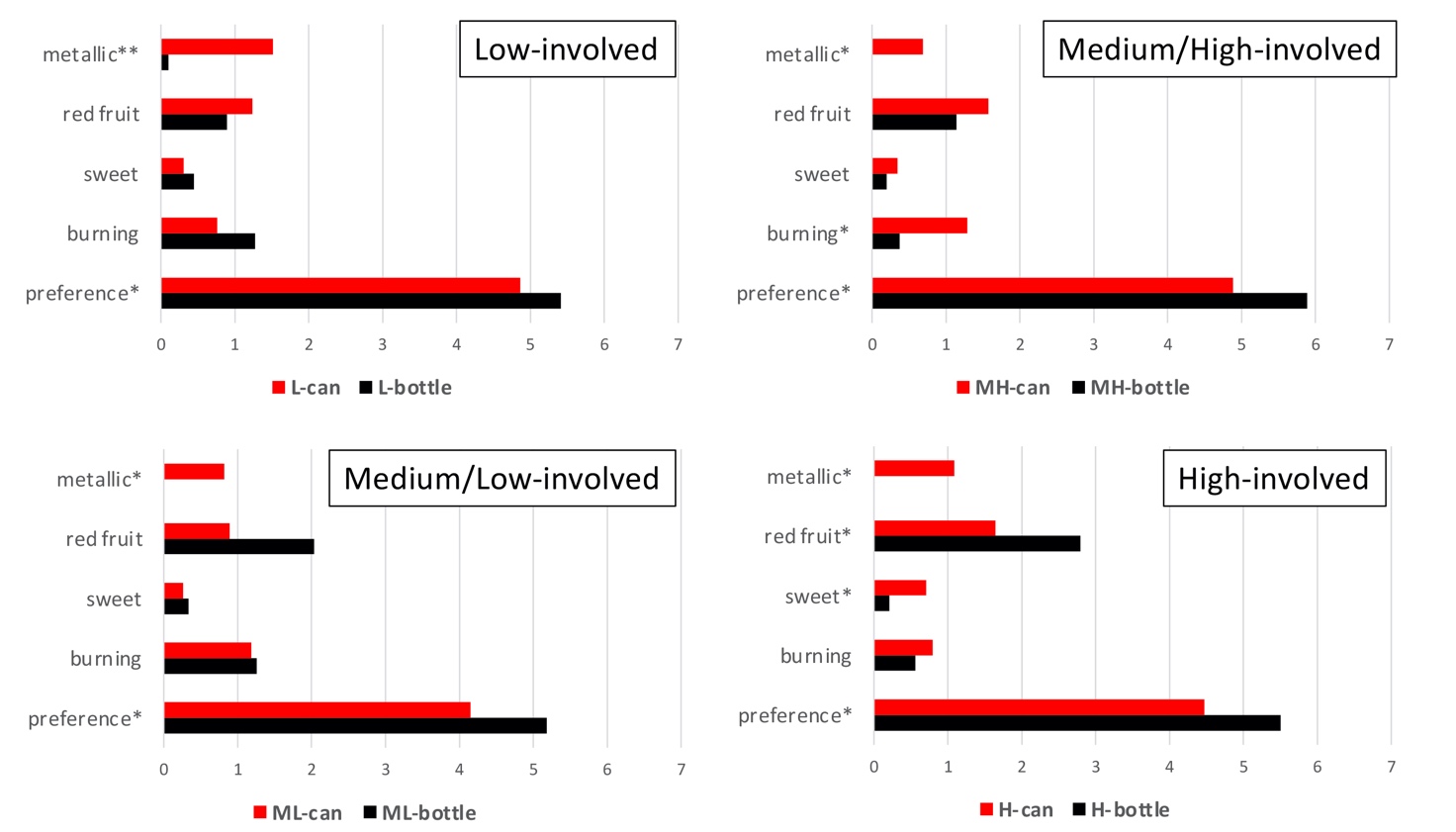
Figure 3. Averaged scores of the descriptors rated for the red wine by the four groups of consumers. Descriptors differing significantly between the can and bottle conditions are marked: *p< 0.05; **p< 0.01.
These results highlight that packaging does not only influence overall perceived quality and liking. It can systematically shift the sensory narrative toward “metallic”, “less fruity”, or “more watery”, even when the product is unchanged, thus confirming the strength of top-down mechanisms in wine perception.
Conclusion
This study suggests that in a traditional market, the can acts as more than a container: it is a cognitive cue that can reshape perceived quality, liking, and even sensory descriptors. Although the sample size does not allow broad generalisation, the results highlight consistent patterns in how packaging and consumer involvement interact to shape perception. Consumer involvement is a decisive factor, because highly involved consumers apply stricter category expectations and are therefore more sensitive to perceived incongruence between wine and packaging (“image mold”). Practically, this suggests that canned wine may be better positioned around specific consumption occasions and younger wine styles, while premium positioning in traditional markets will require stronger credibility signals and expectation management to prevent top-down penalties from dominating the tasting experience.
For producers and marketers, these results highlight the importance of considering consumer involvement when introducing alternative packaging formats, particularly in traditional wine regions where expectations strongly influence perception.
Acknowledgements: This research was funded by the I+D+i project from the Spanish Ministry of Science and Innovation, the Spanish Research Agency and FEDER with grant number PID2021-126031OB-C22 (call: Generación de Conocimiento) funded by MCIN/ AEI/10.13039/501100011033/, and by “ERDF A way of making Europe”.
The authors thank the participants for their time and acknowledge the Gobierno de La Rioja (Bodega la Grajera) for its generous donation of wines.

Notes
- 1. Ferrara, C., De Feo, G., & Picone, V. (2021). LCA of Glass Versus PET Mineral Water Bottles: An Italian Case Study. Recycling, 6(3), 50. https://doi.org/10.3390/recycling6030050
- 2. Morrot, G., Brochet, F., & Dubourdieu, D. (2001). The color of odors. Brain and Language, 79(2), 309–320.
References
- Ferrara, C., De Feo, G., & Picone, V. (2021). LCA of Glass Versus PET Mineral Water Bottles: An Italian Case Study. Recycling, 6(3), 50. https://doi.org/10.3390/recycling6030050
- Morrot, G., Brochet, F., & Dubourdieu, D. (2001). The color of odors. Brain and Language, 79(2), 309–320.
- Sáenz-Navajas, M.-P., Martínez Rodríguez, C., Fernández Zurbano, P., & Valentin, D. (2025). Wine in a can: A consumer study in a traditional wine-producing region. Effect of the level of consumer involvement. OENO One, 59(4). https://doi.org/10.20870/oeno-one.2025.59.4.8470
Article statistics
 Views: 2830
Downloads
 XML: 146