

Increasing grapevine canopy height to compensate for pre-flowering basal leaf removal Sourced from the research article: “Increasing grapevine canopy height to compensate for pre-flowering basal leaf removal” (OENO One, 2025).

Yield loss following intensive pre-flowering leaf removal (LR) can be up to 40-50 % of initial potential. A study conducted by Agroscope on the white grapevine Petite Arvine evaluated the effects of higher hedge trimming to compensate for leaf area removed in the bunch area, either at pre-flowering or flowering stage. The combination of LR at flowering and higher hedge trimming proved to be a good balance, mitigating yield loss caused by earlier LR and slightly improving grape ripening, as well as increasing aroma precursor Cys-3MH accumulation in the must and slightly improving wine composition in terms of color intensity and overall impression.

Leaf removal from the cluster zone at flowering (BBCH 65) stage on grapevine Petite Arvine, Leytron, Switzerland.
Benefits and risks of pre-flowering leaf removal
Early LR in grapevines, performed before berry set, is used to regulate yield and improve grape quality by limiting berry set and reducing disease risk. The success of this practice depends highly on variety, climate, and LR intensity
Material and methods
The complete methods of the trial are described in the original article
A six-year field trial (2016–2021) was conducted in Leytron, Switzerland, to study the effects of time of leaf removal (LR) and canopy height on Petite Arvine grapevines. The experimental design was a randomised block design combining two periods of leaf removal (pre-flowering, BBCH 57, and flowering, BBCH 65) and two canopy heights (100 cm and 150 cm, via hedge trimming). The vineyard had deep, gravelly soil with a high pH and rich in organic matter.
Measurements included vine fruitfulness, yield estimates, leaf mineral content, chlorophyll index, light-exposed leaf area and winter pruning weight. Must and wine analyses were performed for nitrogen content (YAN), aromatic precursor cysteine-3-mercaptohexanol (cys-3MH) in must, and phenolic content in wine, and a sensory tasting was conducted. Data were analysed using ANOVA models taking into account year, LR timing, canopy height and replicates. Sensory analysis was conducted annually with trained panels.
Results and discussion
Table 1 summarises the results of the vineyard measurements, must analyses and wine tastings as a function of either LR timing or trimming height.
Observations | Leaf removal timing | Trimming height | Interaction | |||||
Pre- flowering | Flowering | p-value | 100 cm | 150 cm | p-value | LR timing × Trimming | ||
Vineyard measurements | Bud fruitfulness (clusters per shoot) | 1.7 | 1.8 | * | 1.7 | 1.7 | n.s. | n.s. |
Leaf nitrogen (% dry mass) | 2.6 | 2.5 | n.s. | 2.5 | 2.6 | n.s. | n.s. | |
Leaf phosphorus (% dry mass) | 0.2 | 0.2 | n.s. | 0.2 | 0.2 | n.s. | n.s. | |
Leaf potassium (% dry mass) | 1.6 | 1.7 | n.s. | 1.7 | 1.6 | n.s. | n.s. | |
Leaf calcium (% dry mass) | 3.3 | 3.3 | n.s. | 3.3 | 3.3 | n.s. | n.s. | |
Leaf magnesium (% dry mass) | 0.3 | 0.3 | n.s. | 0.3 | 0.3 | n.s. | n.s. | |
Chlorophyll index mid-August | 523 | 530 | · | 528 | 525 | n.s. | n.s. | |
Early estimated yield (kg/m2) | 0.9 | 1.4 | *** | 1.2 | 1.1 | · | n.s. | |
Cluster thinning (number removed per vine) | 0.4 | 1.9 | *** | 1.4 | 0.8 | ** | *** | |
Light-exposed leaf area (m2/m2 of ground) | 1.2 | 1.2 | n.s. | 1.1 | 1.3 | *** | n.s. | |
Cluster weight at harvest (g) | 139 | 170 | *** | 167 | 141 | *** | n.s. | |
Number of berries par cluster | 160 | 198 | *** | 182 | 176 | n.s. | n.s. | |
Leaf-to-fruit ratio (m2/kg) | 2.1 | 1.3 | *** | 1.5 | 1.9 | · | n.s. | |
Must analyses | Total soluble sugars (Brix) | 23.6 | 23.6 | n.s. | 23.4 | 23.7 | * | n.s. |
pH | 3.01 | 3.01 | n.s. | 3.01 | 3.02 | * | n.s. | |
Titratable acidity (g tartrate/L) | 11.1 | 10.8 | *** | 11.0 | 11.0 | n.s. | n.s. | |
Tartaric acid (g/L) | 9.6 | 9.3 | *** | 9.6 | 9.3 | *** | n.s. | |
Malic acid (g/L) | 4.0 | 3.8 | ** | 3.9 | 4.0 | · | n.s. | |
Yeast assimilable nitrogen (mg N/L) | 265 | 242 | *** | 255 | 252 | n.s. | ** | |
Cys-3MH (µg/L) | 18 | 19 | *** | 17 | 20 | *** | ** | |
Wine tasting (quote 1-7) | Colour intensity | 4.06 | 4.13 | *** | 4.08 | 4.12 | *** | n.s. |
Fruitiness | 4.4 | 4.5 | n.s. | 4.4 | 4.5 | n.s. | n.s. | |
Floral | 2.8 | 2.7 | n.s. | 2.7 | 2.9 | · | n.s. | |
Herbaceous | 1.7 | 1.6 | n.s. | 1.7 | 1.6 | n.s. | n.s. | |
Global nose impression | 4.3 | 4.4 | · | 4.3 | 4.4 | n.s. | n.s. | |
Volume | 4.5 | 4.6 | * | 4.5 | 4.6 | * | n.s. | |
Acidity | 4.5 | 4.5 | n.s. | 4.6 | 4.5 | n.s. | n.s. | |
Bitterness | 2.4 | 2.4 | n.s. | 2.5 | 2.3 | n.s. | n.s. | |
General impression | 4.2 | 4.3 | * | 4.1 | 4.3 | ** | n.s. | |
Pre-flowering LR
Benefits
When compared to LR at flowering stage, pre-flowering LR reduced the yield by 36 % in average and cluster thinning work by 62 %, saving labor costs (Figure 1A). It had no major effect on grape composition at harvest, though it slightly increased titratable acidity (+0.3 g tartrate /L; +3 %), which could be viewed as beneficial in the light of climate change as it leads to lower acidity, and it also slightly increased YAN concentration (+23 mg N/L; +9 %).
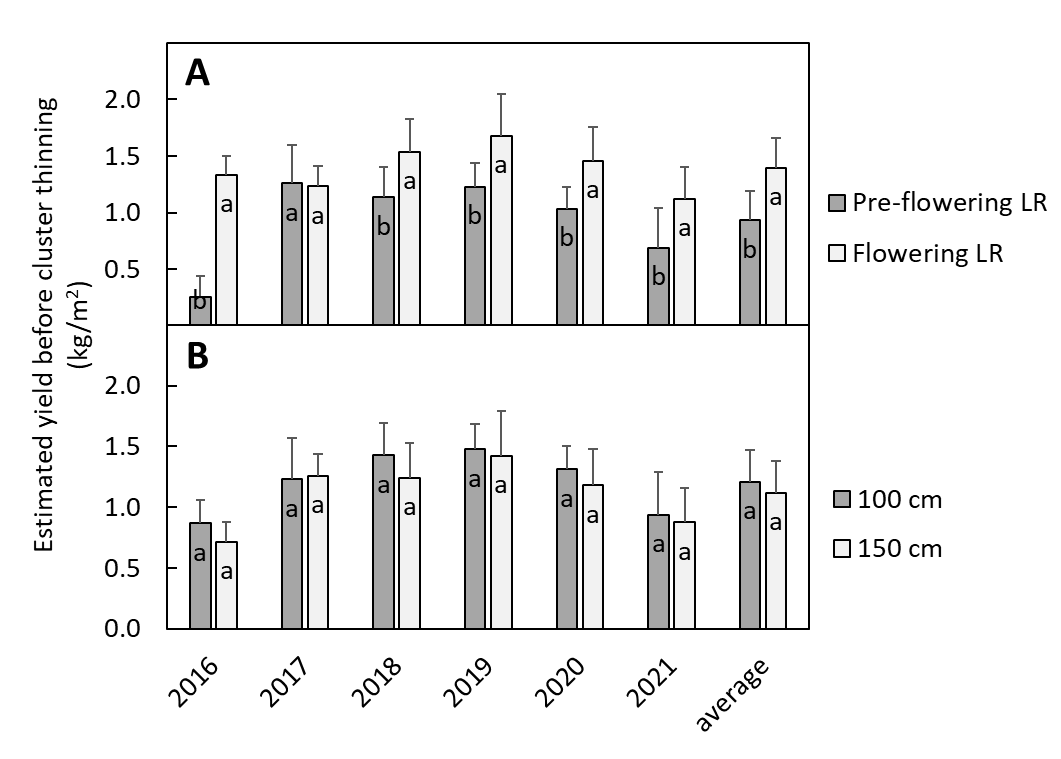
Figure 1. Yield estimated before cluster thinning at cluster closure stage per year, as a function of leaf removal timing (A) and canopy height (B). Error bars are standard deviations. Numbers followed by different letters within a year are significantly different (Tukey’s test, p < 0.05).
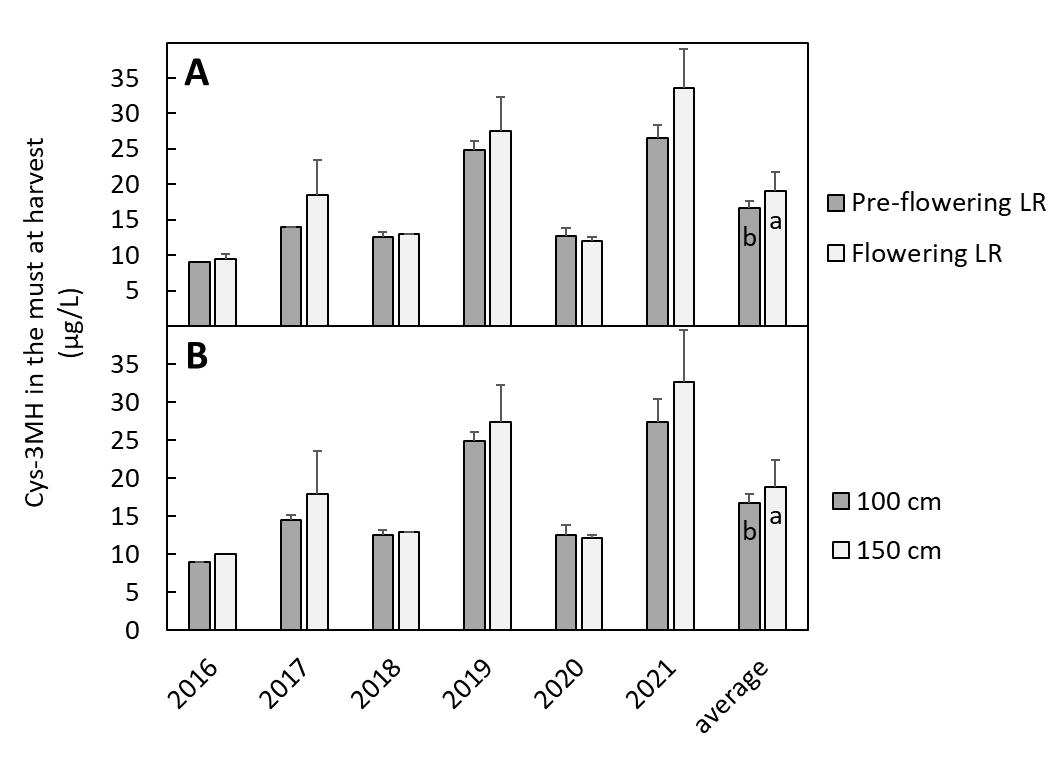
Figure 2. Concentration of aroma precursor Cys-3MH in the must at harvest per year, as a function of leaf removal timing (A) and canopy height (B). Error bars are standard deviations. Numbers followed by different letters are significantly different (Tukey’s test, p < 0.05).
Risks
Yield losses can be excessive and are not always offset by improved fruit chemistry or reduced rot. The effect of pre-flowering LR was dependent on annual weather conditions, with the potential for drastic yield losses under unfavourable conditions (e.g., cold and cloudy weather during flowering in 2016). Pre-flowering LR had a negative impact on Cys-3MH concentration in must (‒6 %), which may have reduce the wine's thiol concentration, impacting flavour profiles. The wines from this treatment had lower polyphenol content (Folin index), lower colour intensity, and lower sensory ratings (general impression).
Increasing Canopy Height
Benefits
Increasing canopy height slightly improved grape ripening, which increased TSS (sugar content) and reduced tartaric and malic acid concentrations in the grapes. It improved the concentration of Cys-3MH in the must of defoliated vines (+18 %; p < 0.0001) and also improved wine mouthfeel and general hedonistic impression.
Drawbacks
Increased canopy height did not fully compensate for yield loss by LR, as cluster weight tended to decrease (‒16 %; p < 0.10), likely due to competition between vegetative and reproductive growth (Figure 1B). The increased leaf area (+15 %) did not result in significant improvements in grape chemistry beyond a modest increase in sugar concentration (+0.3 Brix), and can potentially limit the positive effect of LR against fungal attack (no result). Changes in must composition were relatively small compared to the other LR treatments, showing limited benefits for white wine quality in terms of acidity and sugar content.
Combined effects of a higher trimming at flowering stage
Climatic conditions before the grapevine flowering stage, particularly the low temperature and low light, negatively affected fruit set and exacerbated the effects of early LR. Intensive pre-flowering LR appears to be an excessive treatment, as not only can it lead to excessive yield loss, but it can also have a negative a negative effect on Cys-3MH concentration in the must. Compared to pre-flowering LR, LR at the flowering stage limited yield loss and improved the composition of Petite Arvine grapes by reducing acidity and minimising any decrease in Cys-3MH concentration, especially when combined with higher hedge trimming.
A combination of LR at flowering stage and higher hedge trimming provided a balanced approach, reducing yield loss and slightly improving wine composition, particularly by increasing Cys-3MH accumulation in the fruit, which may improve aromatic quality. More research is needed to understand the physiology behind the formation of aroma precursors.

Notes
- 1. VanderWeide, J., Gottschalk, C., Schultze, S. R., Nasrollahiazar, E., Poni, S., & Sabbatini, P. (2021). Impacts of pre-bloom leaf removal on wine grape production and quality parameters: A systematic review and meta-analysis. Frontiers in Plant Science, 11. https://doi.org/10.3389/fpls.2020.621585
- 2. Verdenal, T., Zufferey, V., Dienes-Nagy, Á., Bieri, S., Bourdin, G., Reynard, J.-S., & Spring, J.-L. (2024). Exploring grapevine canopy management: effects of removing main leaves or lateral shoots before flowering. Oeno One, 58(4). https://doi.org/10.20870/oeno-one.2024.58.4.8175
- 3. Poni, S., Casalini, L., Bernizzoni, F., Civardi, S., & Intrieri, C. (2006). Effects of early defoliation on shoot photosynthesis, yield components, and grape composition. American Journal of Enology and Viticulture, 57(4), 397‒407. https://doi.org/10.5344/ajev.2006.57.4.397
- 4. Noyce, P. W., Steel, C. C., Harper, J. D. I., & Wood, R. M. (2016). The basis of defoliation effects on reproductive parameters in Vitis vinifera L. cv. Chardonnay lies in the latent bud. American Journal of Enology and Viticulture, 67(2), 199‒205. https://doi.org/10.5344/ajev.2015.14051
- 5. Verdenal, T., Zufferey, V., Dienes-Nagy, A., Bourdin, G., Gindro, K., Viret, O., & Spring, J.-L. (2019). Timing and intensity of grapevine defoliation: An extensive overview on five cultivars in Switzerland. American Journal of Enology and Viticulture, 70(4), 427‒434. https://doi.org/10.5344/ajev.2019.19002
- 6. Verdenal, T., Zufferey, V., Dienes-Nagy, À., Belcher, S., Bourdin, G., Reynard, J.-S., & Spring, J.-L. (2025). Increasing grapevine canopy height to compensate for pre-flowering basal leaf removal. Oeno One, 59(2). https://doi.org/10.20870/oeno-one.2025.59.2.8451
References
- VanderWeide, J., Gottschalk, C., Schultze, S. R., Nasrollahiazar, E., Poni, S., & Sabbatini, P. (2021). Impacts of pre-bloom leaf removal on wine grape production and quality parameters: A systematic review and meta-analysis. Frontiers in Plant Science, 11. https://doi.org/10.3389/fpls.2020.621585
- Verdenal, T., Zufferey, V., Dienes-Nagy, Á., Bieri, S., Bourdin, G., Reynard, J.-S., & Spring, J.-L. (2024). Exploring grapevine canopy management: effects of removing main leaves or lateral shoots before flowering. Oeno One, 58(4). https://doi.org/10.20870/oeno-one.2024.58.4.8175
- Poni, S., Casalini, L., Bernizzoni, F., Civardi, S., & Intrieri, C. (2006). Effects of early defoliation on shoot photosynthesis, yield components, and grape composition. American Journal of Enology and Viticulture, 57(4), 397‒407. https://doi.org/10.5344/ajev.2006.57.4.397
- Noyce, P. W., Steel, C. C., Harper, J. D. I., & Wood, R. M. (2016). The basis of defoliation effects on reproductive parameters in Vitis vinifera L. cv. Chardonnay lies in the latent bud. American Journal of Enology and Viticulture, 67(2), 199‒205. https://doi.org/10.5344/ajev.2015.14051
- Verdenal, T., Zufferey, V., Dienes-Nagy, A., Bourdin, G., Gindro, K., Viret, O., & Spring, J.-L. (2019). Timing and intensity of grapevine defoliation: An extensive overview on five cultivars in Switzerland. American Journal of Enology and Viticulture, 70(4), 427‒434. https://doi.org/10.5344/ajev.2019.19002
- Verdenal, T., Zufferey, V., Dienes-Nagy, À., Belcher, S., Bourdin, G., Reynard, J.-S., & Spring, J.-L. (2025). Increasing grapevine canopy height to compensate for pre-flowering basal leaf removal. Oeno One, 59(2). https://doi.org/10.20870/oeno-one.2025.59.2.8451
Article statistics
 Views: 3229
Downloads
 XML: 190